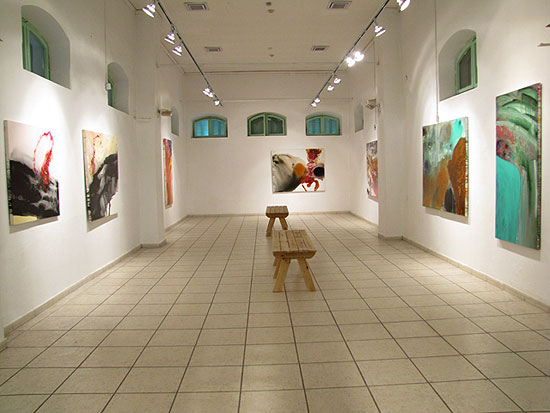
Sara Kahana's large-scale paintings assault the viewer: images composed of large patches of colors are absorbed by the eye, and penetrate deep into the invisible realm of unconscious experience. Based on the instinct to either absorb or resist what appears before him, the observer is compelled to instantly decide how he feels about these images.
This essay is an invitation to engage in a sustained observation of Kahana's works, in an attempt to analyze their enduring resonance in the viewer's mind and to probe those aspects of her paintings that may initially appear enigmatic.
Kahana's relatively large compositions are difficult to take in at a single glance, and our eyes wander over the canvas as we approach them and then step back again. These works are imbued with both power and integrity, and bespeak a process of self-exposure – as if declaring loudly and unapologetically: "I have what to show, and I have nothing to hide!"
When Kahana attempts to put the experience of her works into words, she borrows the image of the painted cloak worn by Saint-Exupéry's Little Prince. Just as the little prince spreads out his cloak as he opens up to the world, so her works reveal themselves before the viewer, attempting to make contact with him as they declare, with painful honesty: "This is who I am!"
Kahana, whose world view is based on an existential approach, is well aware of the frustrating experience of being unable to exceed her own self, body, and limitations. Her philosophical outlook is influenced by the thought of Martin Buber and Shlomo Giora Shoham. Her acceptance of existential limits is not submissive, but rather shaped by conflict and inquiry, as she attempts to exceed these limits and break through them. By deconstructing and reconstructing the images in her paintings, Kahana grapples with the immanent difficulty of accepting the existential approach to life.
Her compositions all contain figures reminiscent of something else – such as an insect attempting to fly, or different body parts: a fragment of the spinal column, a head, a belly, a pelvis, truncated legs. At the same time, the viewer is assaulted by large, powerful, fearless strokes of color, which are imbued with a wild, abstract quality. The figures are composed of abstract elements, elements in motion, which spread out in all directions. In an earlier series titled "Sisyphean Ladders" (2003), the ladders symbolized the attempt to repeatedly grasp onto something. Over time, beginning with the series "Faithful Hands" (2004–2005), and later in the series "Butterfly Merry" (2009), as well as in her most recent works, these ladders have been transformed into spinal columns and human figures. Figures are the underlying force in her works – undergoing a Sisyphean process of evolution, of slow and constant change.
In some instance these figures are androgynous, and appear at once powerful and submissive. They are characterized by large pelvises, yet also radiate a phallic quality. This intentional blurring of male and female characteristics suspends them in a space where stereotypical hierarchies are abolished. In this sense, Kahana's work contains a contemporary, subversive feminist statement. The presence of powerful patches of color competes with that of the figure. One can sense the major struggle taking place on the canvas: upper part versus lower part, fleshy body versus patches of color, an ethereal, fluid quality versus a sense of weight and mass, control of the canvas and the painting versus an intentional relinquishing of control. The colors appear to spread freely across the support (the technique used by the artist enables the mixture of acrylic paint and varnish to drip on the canvas in an intriguing manner, which achieves the quality of a watercolor). The canvas seems to exist in a state of tension between absorbing and resisting the paint and between our willingness to absorb these images and our resistance to the figures, whose grotesque, androgynous quality seems to belong to a different zoological order. We vacillate between the experience of wonder provoked by the expressive use of color and the precise, sweeping, violent brushstrokes, and the rejection of the painting's internal "defect," the maiming of its beauty, a disturbing antithesis to perfection. Like the paintings and like Kahana herself, we find ourselves suspended in the space between absorption and resistance.
|